Home>Inside the CARE Mock Global Council: Student Perspectives on Fossil Fuel Phase-Out


20 May 2026
Inside the CARE Mock Global Council: Student Perspectives on Fossil Fuel Phase-Out
As the culminating exercise of the CARE Climate Leadership Program’s Policy Lab, students from across the program came together this May for the first edition of the CARE Mock Global Council, an intensive multi-day simulation exploring one of the defining challenges of contemporary climate politics: how to negotiate a just and coordinated global phase-out of fossil fuels.
Moving Beyond Theoretical Analysis
Developed as the applied component of the CARE Climate Leadership Program, the Policy Lab invites students to move beyond theoretical analysis and engage directly with the political, financial, social and governance dimensions of climate action. Over the course of the semester, interdisciplinary student teams worked on concrete policy proposals addressing different dimensions of a global fossil fuel transition, drawing on the competencies and thematic areas explored throughout the program.
The Mock Global Council served as the final stage of this process. Across three evenings of presentations and discussions, students stepped into the role of advisers and policy experts tasked with responding to the complex realities of climate governance under conditions of uncertainty, inequality and geopolitical tension.
Tackling Fossil Fuel Phase-out through a Variety of Lenses
Student teams explored a wide range of issues at the heart of contemporary climate negotiations and fossil fuel transition debates. Several groups focused on questions of climate finance and economic transition, examining how international financing mechanisms, fiscal instruments, public investment strategies or retirement funds could support equitable pathways away from fossil fuel dependency — particularly in contexts where development needs, energy access and fiscal constraints remain pressing concerns.
Other teams explored the role of Indigenous leadership, participation and land governance in climate policymaking, asking how climate action frameworks might move beyond extractive or top-down approaches and engage more seriously with questions of sovereignty, rights, historical responsibility and community-led governance.
Questions of climate communication and public narratives also featured prominently throughout the exercise. Students reflected on the political role of storytelling, misinformation, media framing and public trust in shaping support for climate policies, particularly in contexts marked by polarisation, economic anxiety or competing understandings of transition and justice.

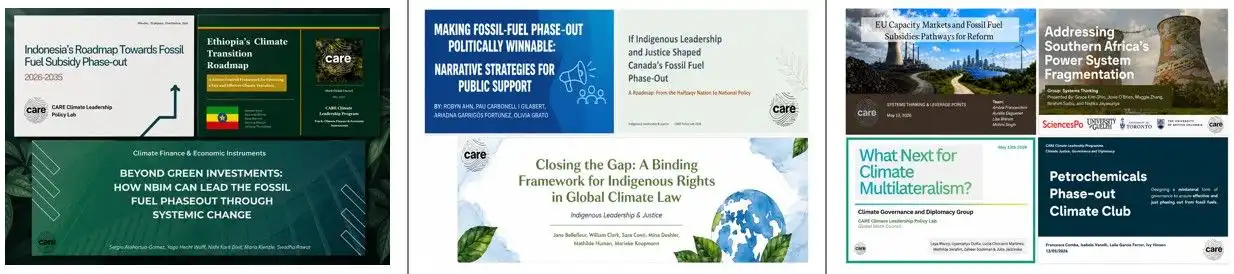
Several proposals adopted systems-thinking approaches to identify leverage points capable of accelerating broader transformation processes across energy, governance and social systems. Rather than focusing exclusively on isolated policy tools, students examined how institutional reforms, financial incentives, behavioural change, regulatory frameworks and social mobilisation interact within larger transition dynamics.
The exercise also highlighted the geopolitical dimensions of fossil fuel phase-out negotiations. Teams grappled with tensions between national development priorities and collective climate commitments, unequal historical responsibilities between Global North and South countries, strategic dependencies linked to energy systems and critical minerals, and the political difficulties of coordinating ambitious transitions across highly unequal international contexts.
Student Proposals and Expert Feeback
The presentations were presented to a jury bringing together academics and practitioners working across climate policy, finance, energy transitions and climate justice. Throughout the sessions, jury members challenged students to refine their assumptions, clarify implementation pathways and consider the broader political implications of their proposals.
The CARE team was particularly struck by the depth of preparation, creativity and collaborative spirit demonstrated throughout the exercise. Students not only produced highly substantive policy proposals, but also showed a strong ability to work across disciplinary perspectives and communicate complex ideas clearly and persuasively.
The Mock Global Council reflects the broader pedagogical approach of the CARE Climate Leadership Program: combining academic rigor with applied, collaborative and practice-oriented learning. At a moment when climate governance increasingly requires the capacity to work across sectors, scales and forms of expertise, the exercise offered students an opportunity to experiment with the realities of collective climate decision-making.
We would like to warmly thank all participating students, mentors, faculty members and jury participants for making this first edition such a rich and intellectually generous experience.
You can learn more about the CARE Climate Leadership Program here: CARE Climate Leadership Program