Home>Reimagining Well-Being Within Planetary Boundaries: Reflections from the CARE-World Sufficiency Lab Sufficiency Project and Summer School


9 June 2026
Reimagining Well-Being Within Planetary Boundaries: Reflections from the CARE-World Sufficiency Lab Sufficiency Project and Summer School
How can cities meet human needs while staying within ecological limits? What would public policy look like if it focused not only on efficiency and technological innovation, but also on sufficiency?
These questions were at the heart of the Sufficiency Project and Summer School, which brought together students and faculty from across the CARE consortium for an intensive week of learning, exchange and applied policy work in Paris.
Over the course of six months, under the supervision of Dr Yamina Saheb from the World Sufficiency Lab (WSL), students from Sciences Po, the University of Toronto, the University of British Columbia and the University of Guelph explored the concept of sufficiency through collaborative research, online workshops and team-based project development. Their work culminated in a week-long Summer School in Paris from 1 to 6 June 2026, combining expert engagement, field visits and the presentation of policy recommendations.
Understanding Sufficiency
While climate discussions often focus on cleaner technologies and improved efficiency, sufficiency invites us to ask a different question: how can societies organize the provision of well-being while avoiding unnecessary resource and energy demand?
The project encouraged students to critically examine how sufficiency principles might inform public policy in sectors ranging from health and water governance to food systems, housing and energy.
Drawing on perspectives from public policy, environmental studies, economics, political science and urban planning, participants explored both the opportunities and challenges of implementing sufficiency-oriented approaches in contemporary cities and beyond.
Learning from Practitioners and Researchers
The Summer School opened at Sciences Po with a presentation by Alice Timsit, Deputy Mayor of Paris in charge of ecological transition, the Climate Plan, water and energy. Drawing on the City of Paris' experience, she introduced students to the ambitions, opportunities and challenges involved in translating climate objectives into concrete public policies.
“Sufficiency is the most immediate and least costly lever of the transition, and often the fairest... Yet it remains the one we discuss the least (…).”
Alice Timsit, Deputy Mayor of Paris in charge of ecological transition, the Climate Plan, water and energy.
Later that day, students had the opportunity to present their projects to a panel of experts and practitioners from the Ville de Paris, the Veblen Institute, RTE and Université Paris Dauphine. Having already reviewed and provided feedback on the teams' draft policy briefs during the online phase of the project, the experts joined the Summer School to engage directly with students, discuss their recommendations and offer further guidance for strengthening their analyses and policy proposals.
These exchanges provided a valuable opportunity for students to test their ideas with practitioners working at the intersection of climate policy, governance and sustainability transitions, while refining their work ahead of the final presentations at the Académie du Climat.
The following days combined expert lectures, workshops and discussions with opportunities for students to test and refine their own policy proposals through direct engagement with practitioners and researchers.
Throughout the week, participants explored the theoretical foundations of sufficiency through dedicated sessions with leading scholars in the field, such as University of Michigan’s Thomas Princen. These discussions encouraged students to critically reflect on dominant approaches to sustainability and climate action, while examining how sufficiency might reshape understandings of prosperity, well-being and resource use. Alongside these conceptual discussions, students took part in a series of practical workshops designed to strengthen their policy analysis and communication skills.


Opening session on Monday 1 June with Alice Timsit and Adrien Sartre


Students present their work to experts from RTE and the city of Paris.


Workshop with Thomas Princen
Exploring Places of Transition
Throughout the Summer School, students had the opportunity to engage with a range of field-based learning experiences that connected classroom discussions to real-world examples of climate action and socio-ecological transition.
Early in the week, participants visited the Boucle Nord de Seine cooling network, an innovative district cooling system that provides low-carbon cooling to buildings across the metropolitan area. The visit offered insights into the challenges of adapting cities to rising temperatures while reducing energy demand and environmental impacts.
Students also travelled to Rosny-sous-Bois to learn about the municipality's efforts to reconcile urban development with environmental stewardship. Through discussions with the city's Department for Research and Innovation, they explored how local authorities are seeking to meet growing needs for public infrastructure while preserving shared environmental resources. Particular attention was given to the construction of schools using natural materials such as straw, adobe and timber, as well as to efforts to involve local communities and educate children about the environmental choices embedded in the built environment.
A highlight of the programme was a field visit to northern France, where students explored the region's experience of social, economic and environmental transformation.
In Loos-en-Gohelle, participants learned about local efforts to build a more sustainable future in a former coal-mining territory. Through discussions with local actors, they examined how questions of participation, social justice, ecological restoration and long-term vision have shaped the municipality's approach to transition and territorial development.
The group also visited the Canadian National Vimy Memorial, reflecting on the environmental legacies of conflict, the transformation of landscapes over time and the multiple layers of recovery and transition that continue to shape the region today. Discussions highlighted the ways in which environmental, social and historical dimensions intersect in places marked by both destruction and renewal.
Taken as a whole, the field visits offered participants a unique opportunity to connect classroom discussions with concrete examples of climate adaptation, territorial transformation, resilience and collective action.


Charlotte PICARD, Deputy Director - Research & Innovation Department, leading the visit "Pee for the Planet" in Rosny-sous-Bois, Greater Paris


An elected representative in Loos-en-Gohelle giving a sustainable development tour to students


Dr. Yamina Saheb and a group of students visiting a cooling plant in Paris
Student Projects: Applying Sufficiency to Real-World Challenges
Working in interdisciplinary and international teams, students developed policy briefs addressing a range of contemporary urban challenges through a sufficiency lens.
- Caring for an Ageing Paris: Four Sufficiency Infrastructures (Anoushka ANOUSHKA, Sara COLADONATO, Jessica RYAN, Harmanbeer SANDHU, Fatma Selen VATANSEVER, Anlin ZHOU)
- Enough, Not Everything: A Sufficiency Threshold for Universal Healthcare (Spandana CHEREDDY, Michael LAMBONGO, Chiara NURY-KOCH)
- Beyond Efficiency: Five Steps Toward Water Sufficiency in Toronto and Paris (Medha BHUSHAN,Saba KHAN,Gabriela PEÑA MANCERO, Sophie SCHUT,Evelyn MANG)
- Smart Meters Without Energy Poverty: A Sufficiency Design for Electricity Digitalisation (Adya Aiswarya DASH, Chiara HAMPTON , Maria PUCHALSKA)
- Embedding Food Sufficiency in the Canada-Mercosur FTA (Yixuan CHEN, Sydney HERRINGTON, Gabriela MATHEW, Maria QUINONES VELASCO, Ninon SALORT, Fée VAN CRONENBURG)
Throughout the week, with the support of Ana Diaz Vidal who acted as a research assistant throughout the project, teams refined their analysis and recommendations through peer exchange and expert feedback.
The programme concluded with a public presentation event at the Académie du Climat, where students shared their findings and policy proposals with invited guests, faculty members and practitioners. The presentations demonstrated not only a strong understanding of sufficiency as a policy framework, but also the creativity and critical thinking required to translate ambitious ideas into actionable recommendations.

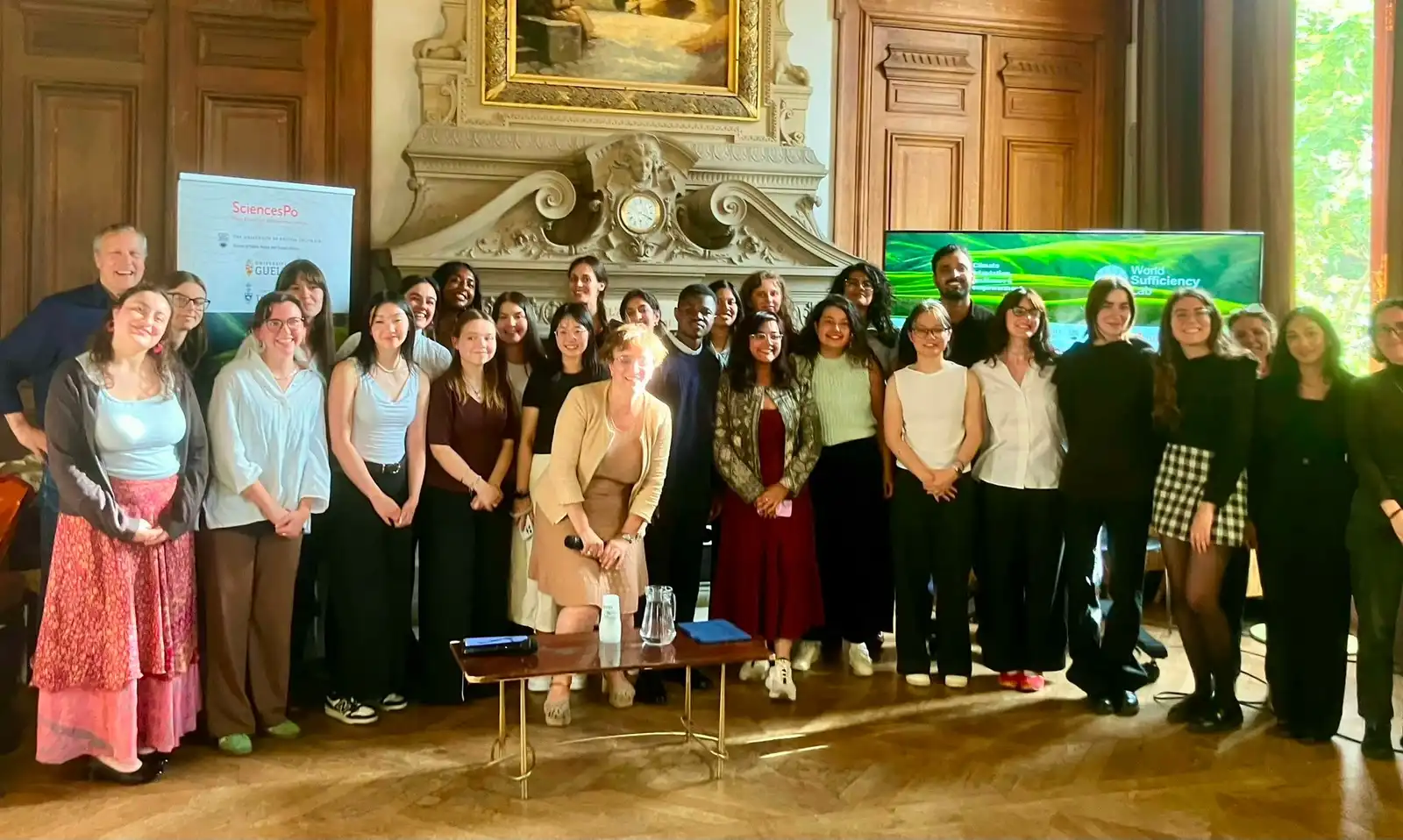
Building Climate Leadership Through Collaboration
Beyond the policy outputs themselves, the Sufficiency Project highlighted the value of international and interdisciplinary collaboration in addressing complex climate challenges.
By bringing together students from different academic backgrounds, countries and professional interests, the programme created a space for collective learning, constructive debate and shared problem-solving. Participants were encouraged to move beyond disciplinary boundaries and to engage with climate action as a question of governance, justice and societal transformation.
As climate challenges continue to intensify, initiatives such as the CARE WSL Sufficiency Project demonstrate the importance of creating opportunities for students to connect theory and practice, engage with real-world stakeholders and develop the skills needed to contribute to sustainable and equitable transitions.
The CARE team would like to warmly thank all students, faculty members and partners who contributed to the success of this year's programme. We look forward to continuing these conversations and supporting the next generation of climate leaders through future CARE initiatives.
Find out more on CARE Program on our LinkedIn.