Home>CARE Climate Leadership Program


21 April 2026
CARE Climate Leadership Program
A pathway to climate action, grounded in practice
The CARE Climate Leadership Program is a flexible, fully online graduate-level program designed to help students develop the skills, tools, and experience needed to engage with climate action in professional contexts.
The program combines asynchronous learning — allowing students to engage with core content at their own pace — with live, faculty-led webinars focused on discussion, application, and collective reflection. This structure enables participants to build foundational knowledge independently, and then deepen it through interactive sessions, case-based discussions, and collaborative exercises across institutions and time zones.
“The CARE Climate Leadership Program significantly shaped my approach to climate leadership… reinforcing the importance of cross-sector collaboration, inclusive leadership, and evidence-based advocacy.”
— Nishi Kant Dixit, University of British Colombia
Bringing together students, faculty and practitioners from Sciences Po, the University of Toronto, the University of British Columbia, and the University of Guelph, the program creates a learning environment where different disciplinary approaches and perspectives intersect, reflecting the complexity of real-world climate challenges.
A learning journey from knowledge to practice
Across the year, students move through a structured sequence of modules, each combining:
- Asynchronous content (videos, readings, guided reflections)
- Applied exercises and individual work
- Live webinars led by faculty, focused on discussion and application
- Peer exchange across institutions
This design allows participants to progressively build both analytical understanding and practical skills, while remaining anchored in their ongoing studies.
Reflecting on this experience, one participant noted:
“The program had an extremely human-centered approach… providing me with more confidence and a stronger conviction to work in the climate field.” — Mailie Besson, Sciences Po
Throughout the program, students develop a Leadership Practice Plan, helping them identify their strengths, clarify their trajectory, and connect learning to their own professional contexts.
The program culminates in an applied CARE Leadership Policy Lab, where students work in interdisciplinary teams to address real-world challenges, supported by mentors and faculty.
Program Modules & Faculty

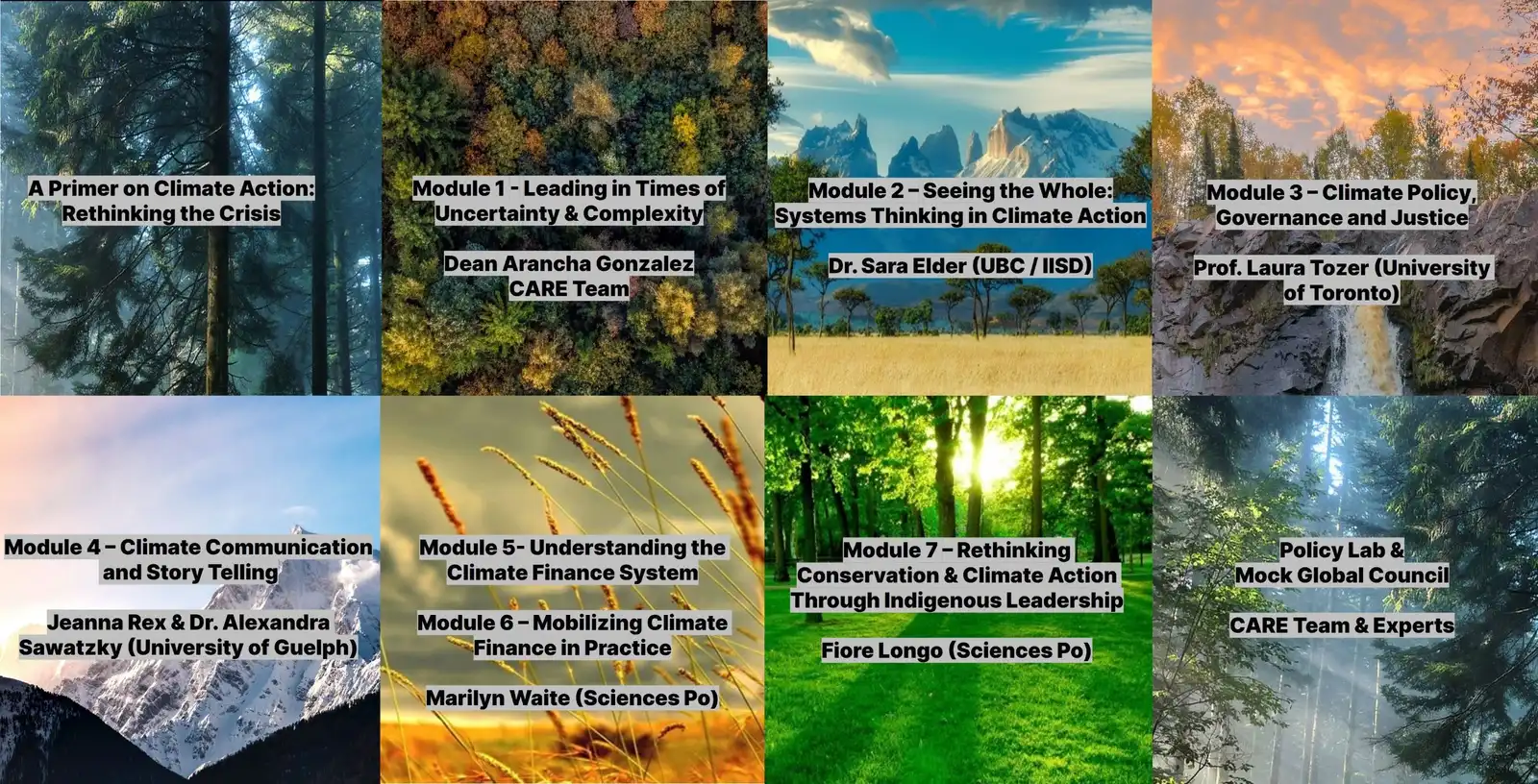
The Foundations Primer provides a shared entry point into the program, introducing key concepts in climate science, governance, and policy. Through a combination of short lectures and guided reflections, students explore core frameworks such as carbon budgets, net-zero pathways, and international climate agreements.
Beyond providing technical grounding, the module encourages participants to critically examine how these frameworks shape political choices and policy debates. It sets the stage for the rest of the program by fostering a systems-oriented and reflective approach to climate action.
This module introduces leadership as a practice that unfolds in conditions of uncertainty, complexity, and constraint. Through asynchronous content and live sessions, students engage with concepts such as adaptive leadership, emotional intelligence, and decision-making under pressure, while reflecting on their own experiences and assumptions.
The module emphasizes leadership as relational and context-dependent, rather than purely technical. It also introduces the Leadership Practice Plan, encouraging students to begin articulating how they want to lead in climate-related contexts.
This module develops systems thinking as a core competency for engaging with climate challenges. Students learn to map complex systems, identify interdependencies, and locate leverage points where interventions can have meaningful impact.
Through applied exercises and collaborative discussions, the module highlights the importance of working across disciplines and stakeholders. It equips participants with tools to move beyond linear problem-solving and to engage with climate issues as dynamic, interconnected systems.
This module explores how climate policy is designed, negotiated, and implemented across different levels of governance. Students engage with policy instruments, institutional dynamics, and global frameworks, while examining how these intersect with questions of equity, justice, and power.
Through case-based discussions and critical analysis, participants are encouraged to reflect on the trade-offs and tensions inherent in climate policy. The module positions policy as both a technical and political process, requiring careful navigation of competing interests and values.
This module focuses on communication as a central dimension of climate action. Students explore how narratives, values, and emotions shape public engagement, and develop skills in storytelling, framing, and audience-aware communication.
Through creative exercises and reflection, the module emphasizes communication as both a strategic and relational practice. It encourages students to consider how to communicate across differences and to build trust in contexts where climate issues are often contested.
This module introduces the key structures and dynamics of climate finance, focusing on how capital flows and why many climate solutions struggle to secure funding. Students explore the roles of public, private, and blended finance, and examine how investors assess risk, return, and impact.
Through applied cases and simulations, participants learn to diagnose financing challenges and design strategies that make projects more investable. The module emphasizes real-world decision-making, helping students understand how financial systems shape what climate action becomes possible.
This module critically examines dominant approaches to conservation and climate governance, focusing on their historical and political dimensions. Students explore how ideas of “nature” and conservation have been shaped, and how they continue to affect communities today.
At the same time, the module highlights Indigenous-led approaches to environmental governance, emphasizing alternative models grounded in long-standing relationships to land and community. It invites participants to engage with climate action through questions of power, knowledge, and justice.


Dr. Sara Elder
UBC - IISD


Prof. Laura Tozer
University of Toronto


Dr. Alex Sawatzky
University of Guelph


Jeanna Rex
University of Guelph


Marilyn Waite
Sciences Po


Fiore Longo
Sciences Po I Survival International
The CARE Leadership Policy Lab
The Policy Lab is the applied core of the program. Working in interdisciplinary teams, students develop responses to real-world climate challenges, supported by mentors and faculty.
Throughout the process, students are mentored by experts and faculty from across the CARE consortium, who provide guidance, feedback, and insight drawn from both academic and professional experience.
Over the course of the Lab, teams define a problem, design a policy or strategic response, and refine their proposals through iterative feedback. The process culminates in a Mock Global Council, where students present their work to an external jury composed of academics and practitioners.
This final stage simulates real-world policy environments, requiring participants to defend their proposals, respond to questions, and engage with diverse perspectives. It provides hands-on experience in collaboration, policy design, and communicating evidence-based ideas to decision-makers.
As one student described:
“CARE created a space for grappling with the uncertainties of real-world climate action while exploring practical pathways to resilience and impact.” — Lea Dakhle, Sciences Po
Program Development Team
The CARE Climate Leadership Program has been designed and developed by a dedicated team at Sciences Po, working in close collaboration with partners across the CARE consortium.
- Dr. Céline Cantat — CARE Program Director, Sciences Po (PSIA)
- Sabina Michael — Program Development and Pedagogy
- Farida Moumeni — Learning Design and Digital Implementation
The team works at the intersection of academic design, pedagogy, and program coordination, ensuring that the program combines intellectual rigor, practical relevance, and an engaging learning experience for students across institutions and formats.
A community of practice
More than a course, the CARE Climate Leadership Program is a community of learning and practice, connecting students, faculty, and professionals across institutions and disciplines.
Participants consistently highlight the value of engaging with diverse perspectives and experiences. As one student put it:
“There are some very interesting people in the program and I feel that is the most valuable asset that should be leveraged. Networking with purpose should also be an outcome!” - Sergio Atehortua Gomez, University of Toronto
The program is designed not only to build knowledge, but to support participants in thinking, working, and acting differently in response to complex climate challenges.